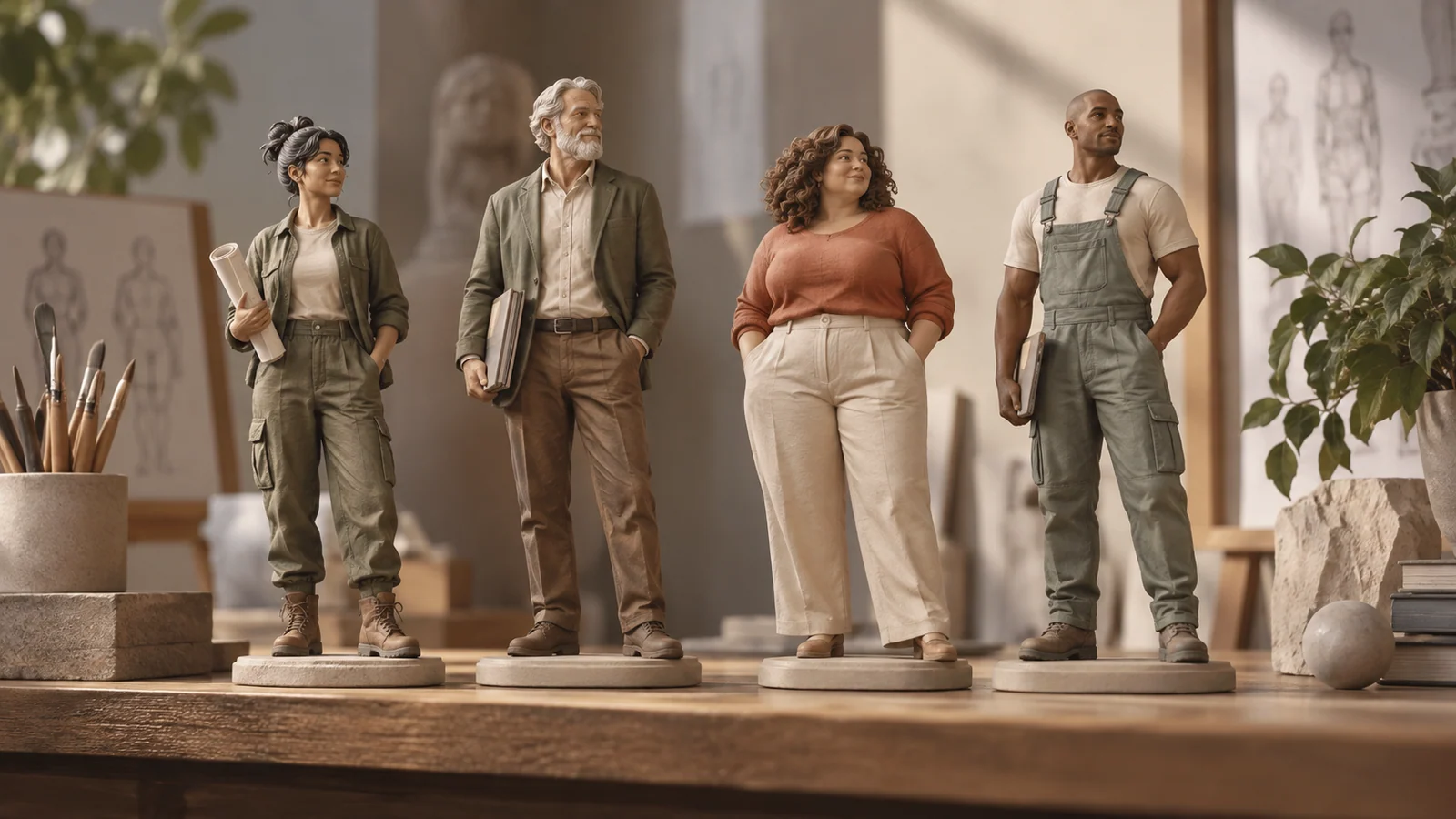
Key takeaway (TL;DR) Waist-to-hip ratio (WHR), a familiar parameter in body ergonomics and evolutionary psychology, points to tendencies in how people perceive health and proportional balance in body contours within particular historical and visual contexts. JVDS emphasizes that, in digital humans, brand mascots and commercial visual identities, research figures such as 0.70 for women and 0.90 for men are only clues for understanding form and balance. They must never become a universal beauty standard. Respecting the diversity of real bodies and making a character fit its professional role and context are the foundations of a relatable brand asset.
1. Research origins: evolutionary hypotheses and sample limitations
Commercial advertising and character design often overstate the idea of a “golden waist-to-hip ratio.” Examining the research behind it helps designers move beyond rigid numerical rules.
A two-dimensional model of body-proportion perception and changing aesthetics
- Biological signaling hypotheses: an evolutionary baseline. Early psychological studies using particular line drawings proposed statistical links between a WHR near 0.70, fat distribution, endocrine health and reproductive fitness. These formed an initial biological hypothesis about bodily attractiveness.
- Cultural and historical change: contextual reconstruction. In food-scarce environments and some cultures, fullness and greater body fat have been associated with wealth and survival. Perceptions of beauty change with access to resources, social class and the division of labor.
- Dynamic anatomy and skeletal continuity: practical implementation. Physical mannequins and 3D characters are affected by perspective and camera movement. Static measurements must give way to coherent biomechanics and anatomy, rather than producing rigid, abrupt bends.
- Business and brand-role fit: meaningful resonance. Contemporary branding looks beyond a single stereotyped body parameter. A character's responsibilities and the brand's values should guide the creation of healthy-looking, relaxed and inclusive visual assets.
- Devendra Singh's early experiments. In 1993, University of Texas psychology professor Devendra Singh used line-drawing tests to report that participants in a particular sample tended to find female figures with a WHR around 0.70 more physically attractive. He proposed that this proportion reflected estrogen levels and healthy visceral-fat distribution. Research on male figures has often used 0.90 as a proportional reference.
- Corrections from multiple variables and cross-cultural differences. Later anthropological and psychological research challenged single-variable explanations. In traditional farming or pastoral communities where food was scarce, higher body weight and fuller waists were often treated as positive signals of wealth and reproductive survival. In a 1995 experiment involving male figures, occupational reputation and economic resources weighed more heavily in attractiveness judgments than waist-and-hip outlines alone. No single dimension can independently define human attractiveness.
- The changing history of fashion mannequins. The mannequins created for the fashion industry by Adel Rootstein from the 1960s onward illustrate this changing balance. Although their waist-and-hip contours maintained an elegant, extended proportional baseline, their postures, shoulder widths, hairstyles and muscular definition changed dramatically with the hippie movement, punk and the growing visibility of women in professional life. Contours serve the mood of an era, not cold numbers.
2. Three traps in translating physical bodies into digital characters
Applying a formula blindly can seriously undermine virtual idols, game characters, corporate digital employees and illustrated brand figures.
- Disconnecting perspective from deformation in motion. A 3D model exists in motion and perspective projection. If a designer rigidly enforces a 0.70 ratio in a front-facing orthographic view, the continuous curve between pelvis and waist can become unnaturally stretched or sharply kinked during running, twisting or low-angle shots, creating visual discomfort.
- Repetitive stereotypes and aesthetic fatigue. Giving every employee illustration or service avatar the same influencer-like face, tiny waist and exaggerated hips weakens a brand's professional credibility. It can also attract criticism for lacking respect for gender diversity and inclusion.
- A mismatch between occupational role and ergonomics. A female specialist depicted doing warehouse handling, demanding engineering exploration or polar fieldwork needs a physique that plausibly supports that work, including the back, obliques and core. Forcing an exceptionally narrow waist to meet 0.70 can make the character appear implausible and unprofessional to knowledgeable buyers.

3. A four-dimensional comparison matrix for digital brand characters
The following matrix helps teams establish healthy, professional standards for brand design and virtual-character development.
| Evaluation dimension | Frequent core functions or assets | Occasional but necessary functions or assets | Redundancy, false functionality or empty styling |
|---|---|---|---|
| Character positioning and professional credibility | Create healthy, relaxed and coordinated postures appropriate to specific roles, such as a senior clinician or architect. | Provide a character library with varied body types, skin tones and cultural characteristics for different regions and international operations. | Use the same unrealistic, exaggerated narrow-waist and oversized-hip cartoon body regardless of industry or profession. |
| Clothing construction and ergonomic comfort | Use realistic workplace-fabric drape and well-fitting cuts to communicate a composed, capable professional presence. | Give outdoor or extreme-sport characters clothing with plausible wear-resistant pads and structural support. | Make a 3D character's formal clothing display physically implausible tightness merely to satisfy one body-ratio target. |
| Skeleton motion and anatomical continuity | Coordinate the pelvis, spine and rib cage according to biomechanics, producing natural and smooth motion. | Include natural breathing and subtle, plausible weight shifts between the legs in idle animation. | Allow severe waist indentation or mesh intersections during walking, with joints moving like a rigid folding ruler. |
| Brand illustration and social values | Communicate health, openness and vitality while respecting the natural beauty of different ages and body shapes. | Represent frontline employees' confident expressions and actual physical characteristics faithfully in staff presentations. | Use extreme retouching to narrow and distort employees' waists in recruitment or company-culture imagery. |
4. JVDS's context-first approach to character shaping
When JVDS develops brand characters, 3D virtual figures and visual assets for technology companies, our working principle is “role before ratio, life before numbers.”
- Infer anatomy from the role's functional demands. Before constructing a brand-character prototype, we study the client's frontline work and the physical demands of the character's key actions in physical or digital workflows. We work backward from range of motion and load requirements to a plausible distribution of muscle and skeletal mass, so gestures and movements support professional credibility.
- Stress-test deformation from multiple viewpoints. During rigging and animation, we push the virtual character through demanding camera-angle tests. Across 360-degree camera moves and extreme high or low angles, we examine whether the transitions between waist, abdomen and pelvis remain consistent with real soft-tissue deformation, eliminating abrupt or rigid bends.
- Review resonance across diverse groups. Before release, we invite target customers of different genders, ages and cultural backgrounds to participate in blind empathy-based reviews. A character enters the brand-asset standards only after different groups describe it as professional, trustworthy, approachable and worthy of respect. Explore our design portfolio for brand work that combines contemporary human-centered values with commercial expression.

5. Frequently asked questions
Q1: Does waist-to-hip ratio still matter in flat vector illustration?
Its relevance is in understanding visual rhythm. Minimal 2D illustration does not aim for realistic 3D anatomy, but the expansion and contraction of large geometric color areas still determine how lively a composition feels. A restrained curved transition between waist and pelvis can break the stiffness of rectangular forms and give the image a sense of movement.
Q2: How can fashion and clothing e-commerce sites balance aesthetics with shoppers' ability to see themselves in the imagery?
One approach used by leading fashion brands is an inclusive sizing gallery. Alongside the artistic expression of high-fashion models, the same product page shows high-resolution, multi-angle photographs of the garment on real consumers with different heights, weights and waist-to-hip ratios. This lets ordinary shoppers understand the actual fit within three seconds and can reduce returns by more than 30%.
Q3: How should designers respond to a stakeholder who insists on making a virtual spokesperson's waist even thinner?
Start with brand credibility and cross-cultural compliance risks. Explain that pursuing an extremely narrow waist at odds with basic anatomy can undermine a mature, premium brand position and provoke a serious public-relations controversy about objectification and body anxiety. A composed, naturally proportioned female scientist or product architect with a contemporary, intelligent presence is better placed to earn the respect of high-value decision-makers.