Key Takeaway (TL;DR)
The MAYA principle—Most Advanced Yet Acceptable—proposed by Raymond Loewy, the father of industrial design, is a golden balancing principle for commercial innovation and aesthetics. The human mind is governed by two opposing instincts: neophilia, a desire for novelty and stimulation, and neophobia, an instinctive fear of unfamiliar, uncontrollable things. Pioneers too far ahead of their time often become casualties, while stagnant mediocrity is eventually eliminated by the market. Excellent commercial design operates precisely at the outer edge of the audience's cognitive comfort zone, wrapping a revolutionary core in a familiar shell, or carrying a category's most fundamental recognizable traits through a breakthrough form. JVDS advocates MAYA calibration in corporate brand design and website transformation, helping enterprises lead their era while maintaining real commercial conversion.
1. Loewy's Commercial Design Icons: Streamlining and the Khan's Leap
From the curves of the classic Coca-Cola glass bottle and Greyhound coaches to the Shell logo and Air Force One's livery, Raymond Loewy shaped the visual soul of America's twentieth-century industrial golden age.
1.1 A Balancing Beam at the Edge of an Era
Over half a century in commercial design, Loewy arrived at a harsh truth:
- One Step Ahead Makes a Pioneer; Two Steps Ahead Makes a Casualty: If a product's interaction logic and form exceed what its target audience can mentally accommodate, the market will bury it in indifference and fear, however advanced its technology or noble its ideas.
- The Still Water of Mediocrity Creates No Ripples: But if design completely submits to existing habits and offers no breakthrough, the product is quickly forgotten in a fiercely competitive sea of sameness.
The essence of MAYA is to find the maximum degree of advancement that the public can enthusiastically embrace at a particular moment in history.
2. Familiarity vs. Typicality: A Deeper Semiotic Distinction
Many design teams applying MAYA confuse the important difference between familiarity and typicality:
2.1 Familiarity: Physical Memory Accumulated Through Exposure
Familiarity refers to how many times an audience has encountered a specific object in previous life experience, directly connecting to the psychological exposure effect. Driving the same Volkswagen every day produces very high familiarity with its steering-wheel buttons.
2.2 Typicality: The Mental Emblem of a Category's Essential Features
Typicality describes how closely a completely new object matches the mind's abstract mental schema of a species or category's defining features:
- You enter an advanced technology exhibition and encounter a new concept juicer you have never seen before.
- Although you have no historical familiarity with its appearance, the geometric relationship between a feed opening, transparent container, rotating blade, and streamlined base lets your brain confidently conclude within 0.1 seconds: “This is a very cool, advanced juicer.”
- Commercial Lesson: Innovation does not need to reproduce an old product's dated appearance or cling to familiarity, but must skillfully retain its definitive category cues, so users immediately understand what it is and what it offers them.
3. The Classic Three-Chair Thought Experiment: Calibrating Cognitive Distance
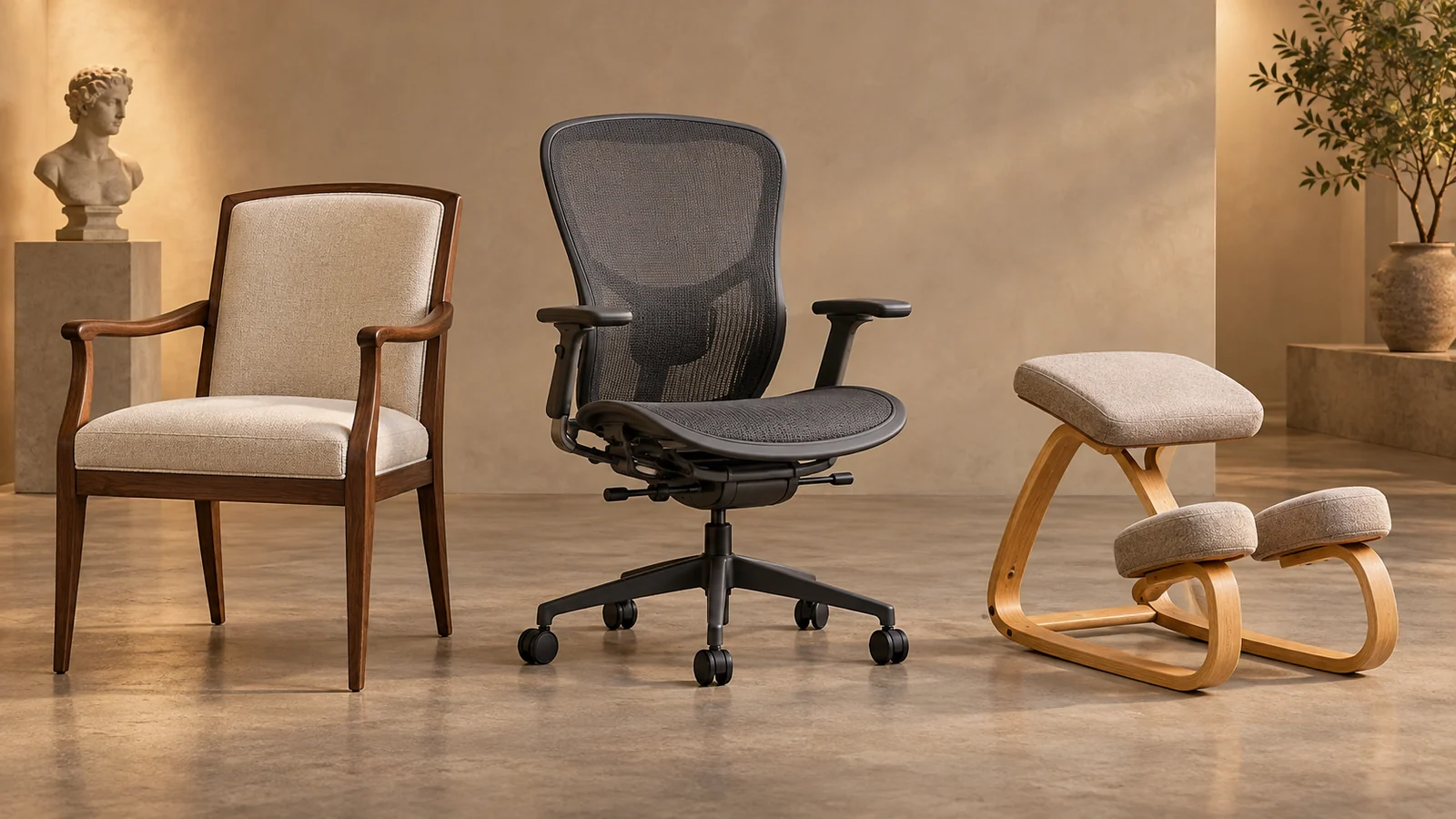
To see exactly how MAYA operates between form and cognition, consider the trajectories of three classic chairs in industrial design history:
[The MAYA Cognitive-Distance Spectrum of Three Classic Chairs]
Traditional Four-Legged Armchair → Herman Miller Aeron Ergonomic Chair → Variable Balans Kneeling Chair
(Too conservative and ordinary) → (The golden MAYA balance) → (Too large a leap forward)
- The Traditional Four-Legged Upholstered Armchair (Over-Familiar / No Advancement): A heavy wooden frame, warm foam padding, and four orderly vertical legs. Everyone recognizes it, but it offers no technical breakthrough and becomes trapped in price competition.
- The Herman Miller Aeron Ergonomic Chair (The MAYA Masterpiece): Designed in 1994 by Bill Stumpf and Don Chadwick, it discarded traditional hot leather and thick foam in favor of a then-unprecedented, fully breathable elastic mesh suspension material. Yet its overall form retained a clear five-star caster base, two armrests, and adjustable lumbar support. It pushed materials and ergonomic mechanics to the forefront while preserving unmistakable chair typicality, becoming a celebrated design that dominated leading technology companies worldwide for 30 years.
- The Variable Balans Kneeling Chair (Over-Advanced / Excessive Cognitive Distance): It eliminates the traditional backrest, using an inclined seat and shin-support pads that require a kneeling posture to keep the spine upright. Although highly advanced in spinal biomechanics, its shape radically overturns longstanding habits of sitting in a chair. Most ordinary users do not immediately understand how to use it and may strongly resist it, confining it over time to smaller circles of enthusiasts and therapeutic rehabilitation.
4. A Comparison Matrix for MAYA in Modern Product and Brand Design
When pursuing digital transformation, website redesign, or new business initiatives, enterprises must precisely calibrate proposals against MAYA:
| Innovation Level | Form and Interaction Strategy | Market Acceptance and Commercial Conversion | Typical Failures and Avoidance Advice |
|---|---|---|---|
| The Golden MAYA Solution (Pioneering and Popular) | • Retain established conventions in the core business structure and primary workflows • Break new ground boldly in visual language, micro-animation quality, and brand storytelling • New wine in familiar bottles, or new bottles containing the most dependable core of familiar wine | Extremely high. Industry critics admire its forward-looking aesthetics while conservative customers can place orders without friction. | A team without conviction lets conservative internal stakeholders gradually remove every distinctive edge, returning the proposal to mediocrity. |
| The Conservative, Ordinary Safe Choice (No Impact) | • Copy an industry leader's outdated layout from 5 years ago pixel for pixel • Use indistinguishable generic open-source templates and components • Remain inside the comfort zone without expressing any brand attitude | Extremely ordinary. It cannot create a distinctive mental foothold in a fiercely competitive mature market and is forced into price wars. | Mistake an absence of errors and novelty for maturity and stability, leaving the brand increasingly dated and marginalized. |
| The Self-Destructive Pioneer (A Cognitive Rupture) | • Overturn established interaction habits, such as replacing mouse scrolling with shaking • Remove all navigation text and require visitors to decipher mysterious abstract symbols • Make the concept so advanced that actual customers cannot understand what the company sells | Commercial failure. It may collect avant-garde design awards while generating zero actual online conversion, wasting the investment. | Founders become absorbed in personal avant-garde artistic obsessions, treating commercial survival as their own performance-art exhibition. |
5. JVDS's Engineering Method for MAYA Calibration
For high-end corporate website rebranding and disruptive business UI/UX design, JVDS proposes a MAYA framework based on carefully measured leaps and dual-track anchoring:
[The JVDS MAYA Innovation Calibration Model]
Map the audience's existing cognitive baseline → Separate inherited structure from avant-garde expression → Anchor typical category features → Stress-test acceptance without guidance
- The 80/20 Innovation Rule: Separating Cognitive Anchors from Avant-Garde Expression: When building flagship portals or software systems for clients, JVDS strictly applies the 80/20 rule. 80% of foundational interactions, including checkout, navigation, and form entry, follow the industry's most mature, stable conventions to ensure operational certainty. The remaining 20% of innovation resources focus on the hero section, micro-animations explaining core technology, and the brand's distinctive expressive language. Customers experience striking, forward-looking aesthetics while business operations remain fluid and mentally effortless.
- Metaphorical Bridging: Explaining the Unknown Through the Familiar: When working with genuinely disruptive concepts that have never existed before, such as complex Web3 smart-contract execution or distributed quantum-computing scheduling, JVDS standards reject invented, opaque jargon. We seek the closest physical metaphor in everyday civilization—for example, representing complex asynchronous parallel pipelines as an intuitive multitrack high-speed rail relay network—so a familiar mental bridge helps an advanced core land smoothly.
- The Cognitive Leap Usability Test: Before an avant-garde proposal is finalized, JVDS requires strict blind testing with 30 conservative target customers from traditional industries. We present two core prompts: “At first glance, what problem do you think this system solves? Without any guidance, please try to complete one core consultation and product-selection task.” Only proposals that make customers say visually, “I have never seen such a striking sense of technology,” while allowing them to complete the entire workflow smoothly within 30 seconds, truly merit JVDS engineering delivery.

6. Frequently Asked Questions (FAQ)
Q1: Did the original iPhone violate MAYA by removing the physical keyboard and leaving a full-touch glass screen?
Quite the opposite: the original iPhone is one of commercial history's greatest MAYA examples. Although removing the keyboard seemed radical, Steve Jobs embedded strong protections of familiarity and typicality in the software. Slide-to-unlock resembled a real sliding drawer; icons felt like physical buttons with reflective highlights and dimensional shadows; text messages became immediately understandable conversation bubbles. It made an exceptionally advanced leap in interaction medium while reassuring the public through familiar physical metaphors, ultimately achieving an extraordinary commercial success.
Q2: Since startups lack an established brand's accumulated recognition, should their design be as radical and unconventional as possible?
Never confuse radical unconventionality with commercial competitiveness. A startup's most serious weakness is not low awareness but a lack of dependable trust among major clients. If unusual website and product layouts are incomprehensible and procurement decision-makers cannot find clear pricing or security credentials, they will instinctively regard the company as an unreliable amateur operation. Startups should use MAYA to create the rigorous, stable order of a mature enterprise combined with a refreshing modern technological edge. That is the sound route to challenging established giants.
Q3: How can we measure whether a new design has precisely reached the golden MAYA balance?
Monitor curiosity engagement at first contact and confusion-driven backtracking in the main workflow. A design that reaches the MAYA balance produces a strong alignment of metrics: attention to the hero section and depth of exploration increase by more than 40% over the old version, showing that novelty has stimulated curiosity and identification. At the same time, errors and confusion-driven backtracking in business forms and checkout fall below 1%, showing that typicality supports operational certainty. Explore the JVDS team's design portfolio for premium design engineering that combines forward-looking aesthetics with robust commercial conversion.